About the project
IndoorCO2Map.com is open source and open data, built by Aurel Wünsch in his free time, without a formal organisation behind it but with input from the community that uses it. But the project itself is really the community: anyone measuring indoor air quality wherever they go, and sharing what they find. No single person or institution could collect data at this scale. Together, we can.
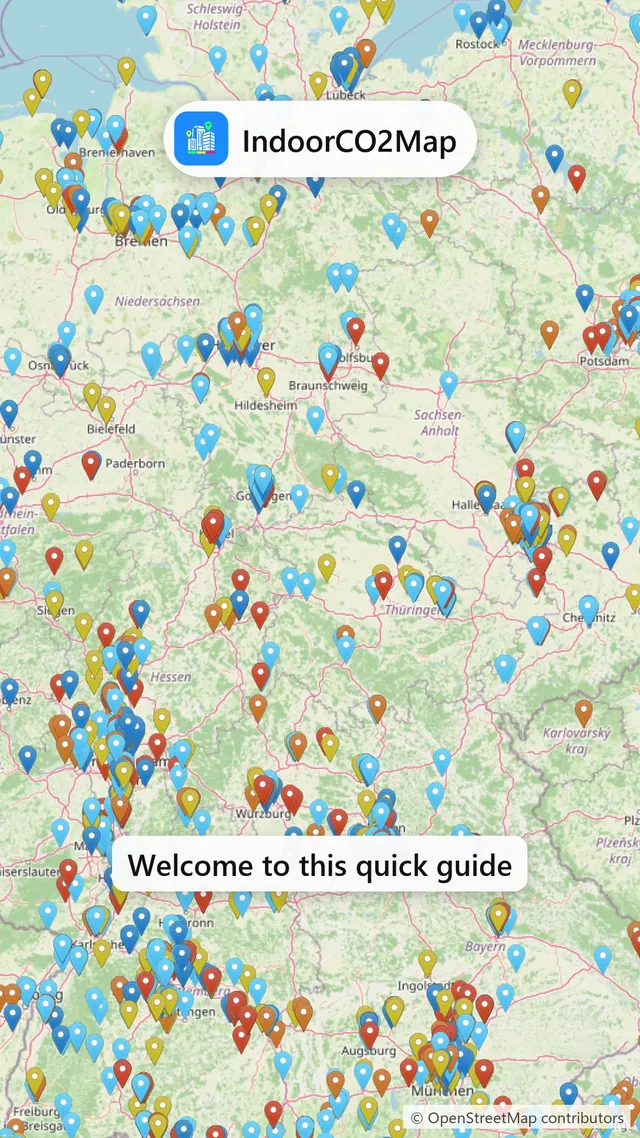
The project started in 2024 with a simple observation: outdoor air quality is monitored almost everywhere, yet there was hardly any data on the air indoors, where we spend around 90% of our time. The idea was to make that air visible in the everyday places people actually go, such as cafés, supermarkets and trains: people carry a portable CO2 monitor, record a reading with the free app and share it on a public map. What began as a one-person side project has since become the largest public dataset of its kind.
Everything is open, from the app’s source code on GitHub to the measurement data itself. Anyone can check how the app works, reuse the data for research, teaching or local community projects, or build their own tools on top of it. The aim is collaboration rather than competition. Privacy is built in as well: measurements are submitted anonymously, no user account is needed, and nobody is tracked.
On the technical side, the guiding principle is to keep things as simple as possible. That is what allows a single person to run and maintain the project in their spare time, and it keeps IndoorCO2Map independent: it doesn’t rely on funding or on the goodwill of governments or companies.
The approach has caught the attention of researchers and the media alike. Aurel was invited to present the project at WIAC 2025, the 6th Workplace and Indoor Aerosols Conference in Gaeta, Italy, to show how citizen scientists can contribute real-world data that complements professional research. And the German business magazine WirtschaftsWoche reported on the project and its findings in October 2025.
See the air quality of indoor spaces near you
Take part
Every reading adds to a bigger picture of the air we breathe. It fits around your day rather than interrupting it: start a recording, carry on as normal, and submit it when you're done. Nothing is collected passively: the app only measures while a recording you started is running.